Black is King is an experiment showing what can be done by merging the forms of cinema and music video. A collaborative work involving many directors, musicians, creators, and performers, this is a work credited to Beyoncé herself. A visual album, something done by this artist before as well as others, but something evolving.
Black is King is tied to the Disney Lion King remake of 2019. Deriving from Beyoncé's work in that film she crafted her own album out of the themes of the film and then from that came this. She uses James Earl Jones' powerful voice, reciting his famous lines as king to punctuate this story of a king.
In this form she is freed from the sort of narrative constraints we're used to in mainstream films, this approximating something more like an art film or series of music videos. Yet she successfully find a narrative to work through this. It isn't a loosely connect series of videos but a true story thread told through her visually striking diversions and the music. It is transformative both as film as as music.
And it is a love letter to both Africa and to Blackness. We have a very short history of celebrating the beauty and power of Black bodies and Black people while we also have a long history of art denigrating those very people. Black is King is a conscious and glorious celebration. Black is King is gorgeous to watch while also being rich and nuanced. It is affirming. It isn't easy or delicate. It challenges its audience at points.
It is remarkable that a film like this comes through a machine like Disney. It is very much the story of The Lion King reinterpreted and re-explored. But it also takes those themes to more complex mature place. Yet this is a fascinating mixing of the corporate drivers and the artistic ambition. The Lion King is such a force in our culture, both as corporate IP and cultural phenomenon. There is some interesting critique to make regarding the corporate nature of all of this but for now Beyoncé has capitalized on that in way to tell a story she wants to tell, and send a message she wants to send. And it is just exciting that something like this can come about in this time, now.
Black is King
Starring: Beyoncé Knowles-Carter, Shawn "Jay-Z" Carter, Lupita Nyong'o, Kelly Rowland, Pharrell Williams, Tina Knowles-Larson, Naomi Campbell, Blue Ivy Carter, Chiwetel Ejiofor, James Earl Jones
Writer/Director: Beyoncé
Friday, 31 July 2020
Tuesday, 28 July 2020
Target Number One/Most Wanted (2020)
Writer/director Daniel Roby decided not to take the easy route when bringing the based on real events story of an CSIS cover up which left a Canadian man dying in a Thai prison. He tells the story from two angles at once, one story set far after the other, until they dovetail and crescendo to their climax. It's an effective tool for a film which sometimes becomes a bit heavy handed but remains entertaining throughout.The cast does great work. Hartnett, freed from his career start heartthrob status, is now able to do character work. His character here has a little too much hero complex, but he pulls it off. Pilon, from Mommy, is quite strong here as he was in that film, bringing a complexity to his junkie character which helps us get into his shoes. But for me is was Gaffigan, cast completely against type, playing a sleazy exploitative low level criminal who steals the show.
A little long, but in the end satisfying, Target Number One manages to tell a very compelling story. It balances the creative license these ripped from the headlines movies have to take with getting the point of the actual events across very effectively. I wish Roby wasn't so dedicated to his wobbly cam (probably for the documentary effect it supposedly creates) which made the film a bit nausea inducing, but he does make this feel authentically powerful. A bit of editing might have helped but over all it is a satisfying film.
Target Number One/Most Wanted
Starring: Josh Hartnett, Antoine Oliver Pilon, Jim Gaffigan, Stephen McHattie, Don McKeller
Writer/Director: Daniel Roby
The Matrix Trilogy (1999 - 2003) REVISIT
When I first saw The Matrix, I was deep into studying deconstruction theory from Derrida through many of the writers which built on those ideas. The premise of a film exploring our world as a construction and a force of heroes dismantling that structure held real promise for me. I remember upon originally seeing it being extremely disappointed for a number of reasons. While the film was a phenomenon and the sequels came almost too late, once the crest of that wave had already broke, I never jumped on that bandwagon, sticking with my criticisms of the series. But for a long time I felt I should give them films another chance and recently I had the chance to do that. Here are my thoughts reflecting as a much more mature film lover.

The film, despite its of-the-time special effects, has a cheap feel to it, perhaps due to budgetary concerns (the film makers didn't know it would be the blockbuster it was so like with the original Star Wars the budget was retrained) but that also fits thematically quite well to create world constructed. It's deliberate and appropriate. Sure the helicopter climax feels somewhat economically filmed and the special effects have a video game quality to them but that helps create the feeling of the film. Everything from the bullet time style to the wuxia appropriation is cinematically on point. For me it was never the technique of the film that felt like a let down, it was the story. As I rewatched the film for the first time in over a decade it all came back to me where it starts to fall apart for me.
There is a common assumption about what makes good film making; "show don't tell." While I am all for challenging these assumptions, most of the time this refrain holds true and here it is evident. The Matrix is all about telling. The characters rarely do things in this film. Most of the time they just explain. So much of the back story is just told to us. This can be a fascinating challenge for a lot of films with complicated plot points. Some films, such as Jurassic Park for example, find a way within the narrative to make explaining details (in that case the animation explaining the cloning process) feel organic to the story. For me The Matrix fails this test. So much time is spent by the characters giving plot details and explaining the world building and so little time is spent actually doing anything proactive.
Other films tackle this problem through being less concrete. For example Blade Runner finds little ways to slip in details of the background but leaves a lot for its audience to interpret which leaves grey area. The Matrix rejects this approach, holding the hands of the audience all the way through, ensuring every little detail is explained and clear so that no ambiguity is left. When it wants to introduce a traitor element, it does show by shoving it in our faces, without any room for doubt in the audience's mind. There is little to no ambiguity through any plot point. The film often overdoes it in that department making sure nothing is left for granted.
This isn't so much a critique. It's a stylistic approach which just doesn't work for me. Perhaps it works for the mainstream audience in a way a film like Mullholland Drive doesn't. Normally I prefer it when any movie asks us to question what we are seeing but here I think it is even more problematic that it spells everything out for us. It's the nature of this specific story which makes this story telling approach so frustrating for me. It is that the film sets up this story about getting us to question our reality, deconstruct what we see as real, and then lays into this very linear, very concrete story, the kind of story that leaves you no room for questions.
This leads into my biggest problem with the film. The film's story ends up being the traditional hero arc about the "one" (who yes happens to be a white straight man) who saves the world by being that thing no one else can be. he does it through being violent and asserting his control. It is the same narrative that we have had time and again, the same narrative that reinforces the very structural beliefs and societal assumptions that a film with this story should be rejecting, should be getting us to question. This is my ultimate disappointment with The Matrix, for all its bravado about being revolutionary it is actually very reactionary, asserting the traditionalist individualist narrative that pervades American cinema and culture. It's Rambo in stylized special effects.
I remember leaving The Matrix the first time feeling a real sense of disappointment that it wasn't something more original, that it's story didn't deliver on its promise. Rewatching it that was confirmed. I got my hopes up and was once again let down.
The Matrix
Starring: Keanu Reeves, Carrie-Anne Moss, Laurence Fishbourne, Hugo Weaving, Joe Pantoliano, Marcus Chong, Mary Alice
Writers/Directors: The Wachowskis
The first thing you notice about The Matrix Reloaded is that they clearly had a much bigger budget. While the first film has a more indie feel to it as the effects often felt cobbled together, here the film makers revel in their new toys, showing off with a spectacular, very Matrixy opening scene showing us just what they are capable of. The set pieces here are very much next level. While watching the freeway chase scene I was reminded how limited the helicopter scene from the first film felt. there is no restraint here.
But it's not just the effects. The mythology and background were expanded, exponentially. The cast has multiplied, the back stories and subplots had grown like tendrils. Everything about The Matrix Reloaded is more. And mostly to the story's benefit. I really enjoyed some of the little diversions, such as Persephone and the Merovingian. I felt it added a richness to the world that the first film lacked. For me this enriching never felt too much, even if the Wachowskis' held little back. All of this amounts to a reworking of what's going on. Reloaded provides us with doubt, questions about what we've been
told is true. This was extremely satisfying due to my disappointment in
the first film's reliance on narrative and myth cliches.
Because by the end of Reloaded we are back at where we ended last time. Neo pulls off hero-mode in the most traditional means available to him. He saves the damsel in distress then saves the other survivors leading to the film's cliffhanger ending. All of the interesting ideas being turned on their head for what, so we can have another savior story. I'm sorry but I found that so unsatisfying. It isn't just that the story feels so common, it's that the film series has purposefully set out the seeds for questioning why these narratives are so threaded through our culture and our expectations, only to then reinforce them and get in line with pop culture tradition. It is the series' boldness in asking the question only to cowardly answer them that I found so frustrating.
I held out hope the third would fix this.
The Matrix Reloaded
Starring: Keanu Reeves, Carrie-Anne Moss, Laurence Fishhourne, Huge Weaving, Jada Pinkett-Smith, Harole Perrineau, Randall Duk Kim, Collin Chou, Monica Bellucci, Lambert Wilson, Leigh Whannell, Gina Torres, Nona Gaye, Harry Lennix, Anthony Zerbe, Mary Alice, Ian Bliss, Anthony Wong, Cornel West
Writer/Directors: The Wachowskis
Sequels which pick up the plot directly from the previous film can face certain challenges, finding a way to introduce to audiences, which (1) haven't seen the previous chapter at all, or (2) haven't just watched the previous chapter, the current status quo and get everyone up to date. Revolutions does a great job of this, finding an in story way of giving us the goods. While I struggle with how these films like to tell us what's going on, at least here it works to get us all caught up for the final chapter, so that we can sum up what's happened and get to the last act.
And there is a lot interesting me here. I wanted this film to address its predecessors' blandness and Revolutions attempts to do that. All the ideas we are leaning that make us question our understanding. "The One" is part of a machine designed failsafe, that there have been other "the One's" before, that the programs are developing human like emotions and relationships (in the image of the creator?). All of this becomes fascinating as we use it to reflect back on what we had seen so far. That maybe this series will break out of the trap that I found the first film falling into.
The final chapter builds up to two monumental battle scenes. Both are spectacular in their own way. The first, the machines attacking Zion and the human resistance fending them off is a traditional action movie set piece. It's like the battle of Helm's Deep, or the destruction of the second Death Star. It's all there, the heroic sacrifices, the gigantic explosions, the sense of impending doom. It is all very exciting. The second, Neo's encounter with the Source, is everything The Matrix fans want, the cable work, the bullet time, trench coats and sunglasses, all the signature slo-mo Matrix moves.
But it's still the same tired saviour narrative the first two films have peddled. Neo is still the one who can save everything without really giving us a reason, the one who everyone else believes in to save them all. They all say it explicitly. Whether its Niobe, or Orpheus, or Trinity (who can't shut up about it), it is all about their belief in him. The film never, never questions this, never asks us to wonder if they are wrong. We are to believe it too. Cause that's what happens in movies. The one hero comes along to save the day.
Maybe I can just accept the films, with their predictable structure just aren't my cup of tea despite all their hipster gloss and gothic overtones. Or maybe I can read into this conclusion something more meaty a little less predictable. I like the ending doesn't force feed us an explanation like so much of the series does before this. There are clues at the end but not concrete exposition like we saw in the previous films. And that gives me hope for this series yet. I know it's popular to shit on the final film but for me it left the most openness and was therefore the most satisfying, even while it was trying to be all things to all matrix fans.
The Matrix Revolutions
Starring: Keanu Reeves, Carrie-Anne Moss, Laurence Fishhourne, Huge Weaving, Jada Pinkett-Smith, Harole Perrineau, Randall Duk Kim, Collin Chou, Monica Bellucci, Ian Bliss, Mary Alice, Harry Lennix, Lambert Wilson, Nona Gaye, Anthony Wong, Cornell West
Writer/Directors: The Wachowskis
Postscript:
Just after I revisited the films information came out about the Wachowskis and their embedding in these stories a trans narrative, a narrative that unfortunately is quite under the surface. Reconsidering based on this does add interesting layers to the film that I didn't as a cis person see. While this is enhanced my experiences with the films somewhat I also find it to continue to confound my experience of the films. As a trans narrative it still centres the cis white male and empowers him through reinforcing cis white male violence. The film makers, perhaps due to the time the films were made, deleted a possibly overt trans character, and kept all references to the trans experience metaphorical and symbolic. I understand how empowering that can remain in narratives for people whose identities are not being acknowledged in mainstream culture at all so I applaud that and certainly it adds something to the film I had been blind to before. But it remains problematic to me for the reasons that it still reinforces the traditional hegemony in ways I find utterly frustrating.
So there is a lot I have come to appreciate about The Matrix on rewatch. I truly enjoyed the esthetic and the Wachowskis' dedication to the grimy, bleak, art deco world they constructed. At the time I remember feeling it ripped off David Fincher, especially his Alien 3, but now I see it as part of a millennial trend taken through many films of the time such as Underworld. It works especially in light of the story's premise, and that with the cyber punk costuming creates a vibe which just fits perfectly for the story.

The film, despite its of-the-time special effects, has a cheap feel to it, perhaps due to budgetary concerns (the film makers didn't know it would be the blockbuster it was so like with the original Star Wars the budget was retrained) but that also fits thematically quite well to create world constructed. It's deliberate and appropriate. Sure the helicopter climax feels somewhat economically filmed and the special effects have a video game quality to them but that helps create the feeling of the film. Everything from the bullet time style to the wuxia appropriation is cinematically on point. For me it was never the technique of the film that felt like a let down, it was the story. As I rewatched the film for the first time in over a decade it all came back to me where it starts to fall apart for me.
There is a common assumption about what makes good film making; "show don't tell." While I am all for challenging these assumptions, most of the time this refrain holds true and here it is evident. The Matrix is all about telling. The characters rarely do things in this film. Most of the time they just explain. So much of the back story is just told to us. This can be a fascinating challenge for a lot of films with complicated plot points. Some films, such as Jurassic Park for example, find a way within the narrative to make explaining details (in that case the animation explaining the cloning process) feel organic to the story. For me The Matrix fails this test. So much time is spent by the characters giving plot details and explaining the world building and so little time is spent actually doing anything proactive.
Other films tackle this problem through being less concrete. For example Blade Runner finds little ways to slip in details of the background but leaves a lot for its audience to interpret which leaves grey area. The Matrix rejects this approach, holding the hands of the audience all the way through, ensuring every little detail is explained and clear so that no ambiguity is left. When it wants to introduce a traitor element, it does show by shoving it in our faces, without any room for doubt in the audience's mind. There is little to no ambiguity through any plot point. The film often overdoes it in that department making sure nothing is left for granted.
This isn't so much a critique. It's a stylistic approach which just doesn't work for me. Perhaps it works for the mainstream audience in a way a film like Mullholland Drive doesn't. Normally I prefer it when any movie asks us to question what we are seeing but here I think it is even more problematic that it spells everything out for us. It's the nature of this specific story which makes this story telling approach so frustrating for me. It is that the film sets up this story about getting us to question our reality, deconstruct what we see as real, and then lays into this very linear, very concrete story, the kind of story that leaves you no room for questions.
This leads into my biggest problem with the film. The film's story ends up being the traditional hero arc about the "one" (who yes happens to be a white straight man) who saves the world by being that thing no one else can be. he does it through being violent and asserting his control. It is the same narrative that we have had time and again, the same narrative that reinforces the very structural beliefs and societal assumptions that a film with this story should be rejecting, should be getting us to question. This is my ultimate disappointment with The Matrix, for all its bravado about being revolutionary it is actually very reactionary, asserting the traditionalist individualist narrative that pervades American cinema and culture. It's Rambo in stylized special effects.
I remember leaving The Matrix the first time feeling a real sense of disappointment that it wasn't something more original, that it's story didn't deliver on its promise. Rewatching it that was confirmed. I got my hopes up and was once again let down.
The Matrix
Starring: Keanu Reeves, Carrie-Anne Moss, Laurence Fishbourne, Hugo Weaving, Joe Pantoliano, Marcus Chong, Mary Alice
Writers/Directors: The Wachowskis
The first thing you notice about The Matrix Reloaded is that they clearly had a much bigger budget. While the first film has a more indie feel to it as the effects often felt cobbled together, here the film makers revel in their new toys, showing off with a spectacular, very Matrixy opening scene showing us just what they are capable of. The set pieces here are very much next level. While watching the freeway chase scene I was reminded how limited the helicopter scene from the first film felt. there is no restraint here.
But it's not just the effects. The mythology and background were expanded, exponentially. The cast has multiplied, the back stories and subplots had grown like tendrils. Everything about The Matrix Reloaded is more. And mostly to the story's benefit. I really enjoyed some of the little diversions, such as Persephone and the Merovingian. I felt it added a richness to the world that the first film lacked. For me this enriching never felt too much, even if the Wachowskis' held little back. All of this amounts to a reworking of what's going on. Reloaded provides us with doubt, questions about what we've been
told is true. This was extremely satisfying due to my disappointment in
the first film's reliance on narrative and myth cliches.
But you know what didn't feel expanded or enriched? Neo and Trinity. The centre of this story still felt so blandly average. Now that Neo is confirmed as "the One" he gets his mission, go to the heart of the mainframe. It's all just so... straight forward. And so is he. He is a blank, bland, white man hero as there ever was. He is the epitome of the stereotype. And I get that could have been the point. But I honestly doubt it is. Nothing in the film tells me they are using this ironically or to prove some point. He just is what audiences expect their movie action heroes to be. He is a cliche and not in a good way.
Never once does the film show me that he is special. It tells me he is over and over but it never gives me the proof. We are told to believe it so we do. He gains abilities and powers and saves the day but never are we given a reason other than he is "the One." Trinity is equally poorly drawn. Other than just loving him she never does anything... except need to be saved. Her arc is as unsatisfying as Neo's. All this other interesting stuff is going on (including Morpheus, and the upending of how we understand Zion and the human resistance as part of the design) but we keep coming back to the boring centre which reinforces the traditional hero arc.
Because by the end of Reloaded we are back at where we ended last time. Neo pulls off hero-mode in the most traditional means available to him. He saves the damsel in distress then saves the other survivors leading to the film's cliffhanger ending. All of the interesting ideas being turned on their head for what, so we can have another savior story. I'm sorry but I found that so unsatisfying. It isn't just that the story feels so common, it's that the film series has purposefully set out the seeds for questioning why these narratives are so threaded through our culture and our expectations, only to then reinforce them and get in line with pop culture tradition. It is the series' boldness in asking the question only to cowardly answer them that I found so frustrating.
I held out hope the third would fix this.
The Matrix Reloaded
Starring: Keanu Reeves, Carrie-Anne Moss, Laurence Fishhourne, Huge Weaving, Jada Pinkett-Smith, Harole Perrineau, Randall Duk Kim, Collin Chou, Monica Bellucci, Lambert Wilson, Leigh Whannell, Gina Torres, Nona Gaye, Harry Lennix, Anthony Zerbe, Mary Alice, Ian Bliss, Anthony Wong, Cornel West
Writer/Directors: The Wachowskis
Sequels which pick up the plot directly from the previous film can face certain challenges, finding a way to introduce to audiences, which (1) haven't seen the previous chapter at all, or (2) haven't just watched the previous chapter, the current status quo and get everyone up to date. Revolutions does a great job of this, finding an in story way of giving us the goods. While I struggle with how these films like to tell us what's going on, at least here it works to get us all caught up for the final chapter, so that we can sum up what's happened and get to the last act.
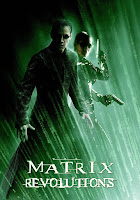
And there is a lot interesting me here. I wanted this film to address its predecessors' blandness and Revolutions attempts to do that. All the ideas we are leaning that make us question our understanding. "The One" is part of a machine designed failsafe, that there have been other "the One's" before, that the programs are developing human like emotions and relationships (in the image of the creator?). All of this becomes fascinating as we use it to reflect back on what we had seen so far. That maybe this series will break out of the trap that I found the first film falling into.The final chapter builds up to two monumental battle scenes. Both are spectacular in their own way. The first, the machines attacking Zion and the human resistance fending them off is a traditional action movie set piece. It's like the battle of Helm's Deep, or the destruction of the second Death Star. It's all there, the heroic sacrifices, the gigantic explosions, the sense of impending doom. It is all very exciting. The second, Neo's encounter with the Source, is everything The Matrix fans want, the cable work, the bullet time, trench coats and sunglasses, all the signature slo-mo Matrix moves.
But it's still the same tired saviour narrative the first two films have peddled. Neo is still the one who can save everything without really giving us a reason, the one who everyone else believes in to save them all. They all say it explicitly. Whether its Niobe, or Orpheus, or Trinity (who can't shut up about it), it is all about their belief in him. The film never, never questions this, never asks us to wonder if they are wrong. We are to believe it too. Cause that's what happens in movies. The one hero comes along to save the day.
And in the end he has saved the day. We think...
I like that finally, at the very end of this opus, there is some potential to see it all differently and perhaps break apart what it is we are assuming. In the end we are given a plot that says he, unlike his previous predecessors, has broken the pattern the machines have started of reloading and rebooting and resetting, and contributed to a better world for the humans who now get to choose to be free or not. Sure he didn't destroy the machines and the humans aren't left liberated to build a new world on the machine's ashes (which to be fair would be the typical end result). He has made a new deal with the machines.
But I do wonder if that's the case. I think you can make an argument he was used, once again by the machines to solidify their control. He helps them eliminate a virus which threatened to destroy them and they keep their human farming operation going. I think there is finally some interesting questions and arguments to end this on. What happens at the end can be interpreted a number of ways and some of them are more interesting than others. Maybe the film makers have left it open enough to allow some wiggle room. And that might be enough to redeem much of this for me.
Maybe I can just accept the films, with their predictable structure just aren't my cup of tea despite all their hipster gloss and gothic overtones. Or maybe I can read into this conclusion something more meaty a little less predictable. I like the ending doesn't force feed us an explanation like so much of the series does before this. There are clues at the end but not concrete exposition like we saw in the previous films. And that gives me hope for this series yet. I know it's popular to shit on the final film but for me it left the most openness and was therefore the most satisfying, even while it was trying to be all things to all matrix fans.
The Matrix Revolutions
Starring: Keanu Reeves, Carrie-Anne Moss, Laurence Fishhourne, Huge Weaving, Jada Pinkett-Smith, Harole Perrineau, Randall Duk Kim, Collin Chou, Monica Bellucci, Ian Bliss, Mary Alice, Harry Lennix, Lambert Wilson, Nona Gaye, Anthony Wong, Cornell West
Writer/Directors: The Wachowskis
Postscript:
Just after I revisited the films information came out about the Wachowskis and their embedding in these stories a trans narrative, a narrative that unfortunately is quite under the surface. Reconsidering based on this does add interesting layers to the film that I didn't as a cis person see. While this is enhanced my experiences with the films somewhat I also find it to continue to confound my experience of the films. As a trans narrative it still centres the cis white male and empowers him through reinforcing cis white male violence. The film makers, perhaps due to the time the films were made, deleted a possibly overt trans character, and kept all references to the trans experience metaphorical and symbolic. I understand how empowering that can remain in narratives for people whose identities are not being acknowledged in mainstream culture at all so I applaud that and certainly it adds something to the film I had been blind to before. But it remains problematic to me for the reasons that it still reinforces the traditional hegemony in ways I find utterly frustrating.
Wednesday, 22 July 2020
First Cow (2020)
I've heard First Cow described as and anti-western western. Westerns are often a reinforcement of values such as individualism and masculinity, as well as colonialism and white supremacy. This film, set in the 1800s, centres two men who quite clearly violate the traditional takes on masculinity and whiteness. One is of Asian descent and the other exhibits qualities many might identify with as being feminine. He's a care giver, a cook, not a fighter. The two of them embark on a business making plan and pay a serious price for it, asking us to question our assumptions not only about capitalism, but about American history.
Director Reighhardt is used to upending our expectations and focusing on characters on the margins. This film embraces that by painting a fairly queer (if not explicitly so) story set in the historical fiction of the American past. He film style hasn't changed, she remains stylistically rather restrained while subverting narrative tropes, while telling a very compelling story. She maybe drags things a bit in the middle, but the first and third acts are very strong and not only drive home her points but get us invested in her heroes and their story.
Beautiful and filled with a delicious sense of mystery, First Cow is fascinating as are the performances of the leads Lee and Magaro. It all comes together in a refreshing spin on an old style.
First Cow
Starring: John Magaro, Orion Lee, Toby Jones, Rene Auberjonois
Director: Kelly Reighardt
Writers: Anish Savjani, Kelly Reighardt
Tuesday, 21 July 2020
Palm Springs (2020)
I didn't think I wanted (or needed) another romantic comedy about being stuck in a timeloop where you have to relive the same day over and over. Turns out Palm Springs is a fun and funny take on the idea which also brings up some interesting things to think about it. Samberg and Milioti have great chemistry, the script is funny, and damn it if it won't make you smile.
That is all.
Palm Springs
Starring: Andy Samberg, Cristin Milioti, J.K. Simmons, Peter Gallagher, Camila Mendes, Tyler Hoechlin, June Squibb, Cliff Johnson
Director: Max Marbakow
Writer: Andy Siara
That is all.
Palm Springs
Starring: Andy Samberg, Cristin Milioti, J.K. Simmons, Peter Gallagher, Camila Mendes, Tyler Hoechlin, June Squibb, Cliff Johnson
Director: Max Marbakow
Writer: Andy Siara
Sunday, 19 July 2020
Much Ado About Nothing (2012) REVISIT
Filmed in only 12 days at the director's own residence, Joss Whedon's film adaptation of Much Ado About Nothing has a very grassroots feel to it. He literally just pulled together a group of his friends to hand out at his house and film the play. While this produces some mixed results, over all the experience is just so damn fun (especially due to the play chosen) that it remains a truly enjoyable film.
What works? The choice to film in black and white, and costume the cast in classic cut suits and dresses gives it an air of timelessness which allows for the language of the text to play out. Whedon's cut of the script is tight and modern, fast paced and funny.
But for me the thing that most works about this film is its star Amy Acker. Her Beatrice is a vision. She is all the complexities a Beatrice needs to be. Standing in the shadow of the great Emma Thompson isn't an easy thing, so taking on this role for a new film must have been daunting. But Acker proves up to the task, making it her own.
Fillion's Dogberry is a treat too. He doesn't play the role too over the top, which is clearly tempting in so many productions I have seen. Instead he is subtly incompetent and imbecilic, an approach which works so very well.
And finally the music is outstanding. The film's new versions of Sigh No More and Heavenly are gorgeous, with their slightly jazzy influence, fitting just right into this mix. The score itself is lush and lovely helping us all feel blithe and bonny.
What doesn't work? Alexis Denisof as Benedick is truly terrible, butchering almost every scene he's in. I don't like to crap so hard on anyone but his Benedick is a mess, never once inspiring the sort of love from a woman like Beatrice necessary for the play to work. There are some other weak spots in the cast but Denisof stands out the most, pulling you out of the story. It's the power imbalance between the two leads which is ever so frustrating. I've always seen Much Ado as being about a few things, one predominantly contrasting a very mature love structured on partnership and equality against a fresh, young, idealistic love which is so easily shaken and pulled apart. I'm not sure this film accomplishes that.
I'm also not sure this film gets into the heart of how the play explores the power dynamics between men and women as effectively as some other films and adaptations. In some ways it treats Hero's shaming and the following comeuppance of her accusers more as plot points than as essential to the entirety of the story.
Still, Much Ado About Nothing is just so damn watchable, so engaging, even a fumbled version can be a true joy. And Whedon's take on it, despite what many may feel about him, remains so damn watchable, especially for Acker and just for it's outright beauty.
Much Ado About Nothing
Starring: Amy Acker, Alexis Denisof, Reed Diamond, Nathan Fillion, Clark Gregg, Fran Kranz, Sean Maher, Jillian Morgese, Spencer Treat Clark, Riki Lindhome, Ashley Johnson
Director: Joss Whedon
Writers: William Shakespeare, Joss Whedon
Saturday, 18 July 2020
Abe (2020)
Abe is a charming idea that may not be executed in the best way but still ends up being pleasing, even if just for the food porn. The film perhaps tackles some issues that it never quite successfully addresses, it's also too short, skipping through some of the work necessary to truly take on those issues. But it's heart is in the right place and Noah Schnapp is outsanding in the title role.
Abe is the story of a boy whose father's family is Palestinian Muslim and whose mother's family is Israeli Jew. His grandparents can't stop fighting about the Middle East and Abe turns to his passion for food and cooking, especially the idea of fusion cuisine (you see where this is going) to get reprieve. He meets a street food vendor from Brazil, Chico, who teaches him about cooking and through this he brings his family together.
Okay yes it's cliched and yes the film presents its problem and solution rather ham-fistedly. But despite all that Abe remains enjoyable. At the centre of this is Schnapp as Abe and he sells it. he's got the makings of a star and he exhibits it here. Also director Fernando Grostein Andrade may fumble some of the narrative aspects but films his story beautifully with a loving eye for the food. You won't be able to come out of this film not feeling hungry.
And despite how elementary the film's take on religion, family dynamics, and interpersonal relationships are, they aren't off the mark. This is a very strong film for young viewers to tackle something a bit more heady than they might get in a standard children's film. For families, Abe is actually quite strong. So in the end Abe satisfies just enough, creating a fusion taste just like its title character would want.
Abe
Starring: Noah Schnapp, Seu Jorge, Dagmara Dominczyk, Arian Moayed, Mark Margolis, Salem Murphy, Tom Mardirosian
Director: Fernando Grostein Andrade
Writers: Lameece Issaq, Jacob Kader, Fernando Grostein Andrade
Subscribe to:
Posts (Atom)


